

From the Vaults of the Unhinged: The Experimental Anti-Flash Visor That Looks Like Sci-Fi but was Dead Serious
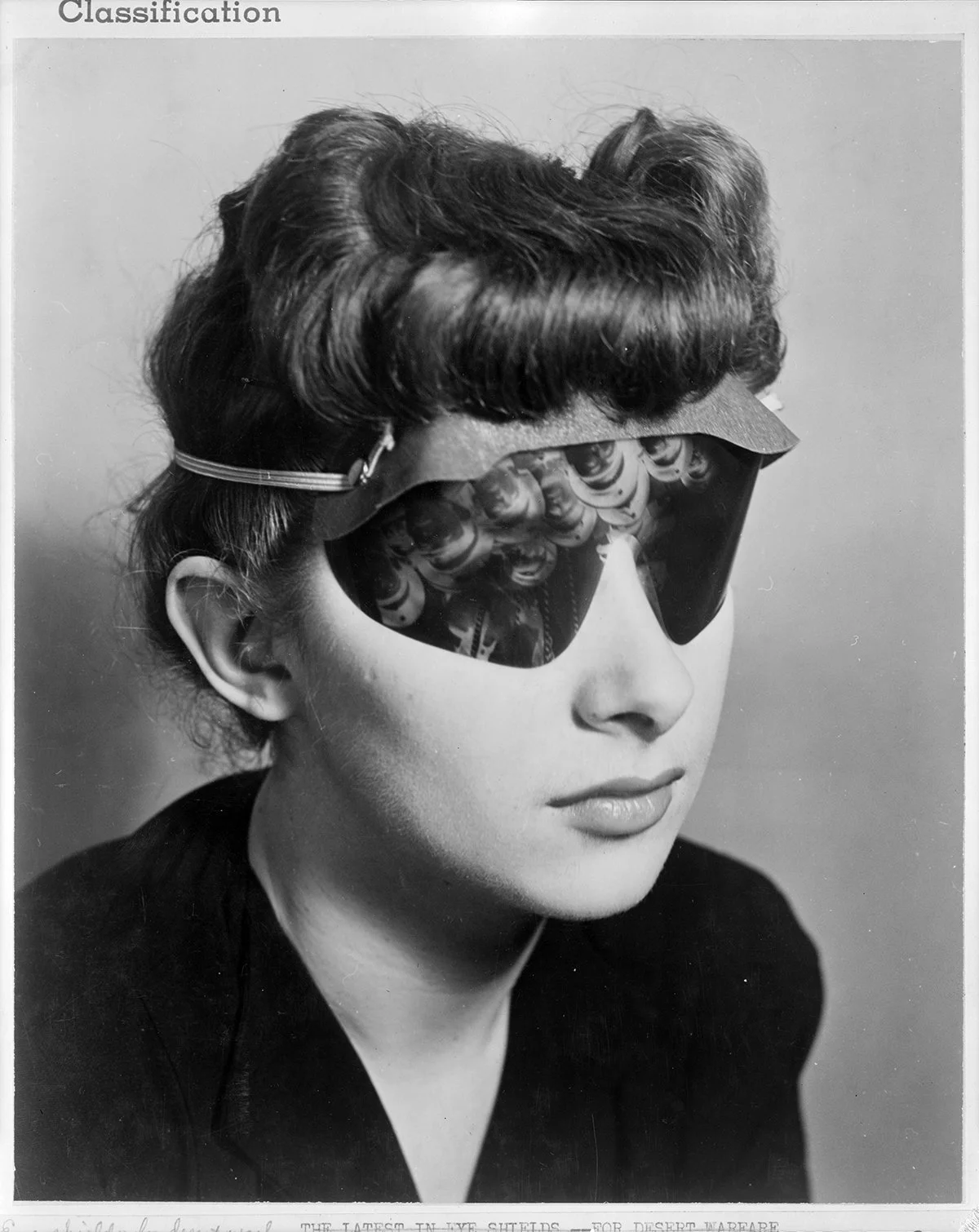
Mid-20th century press or promotional photograph showing an experimental anti-flash /anti-dazzle visor (c. 1948–1955)
Every era leaves behind artifacts that feel almost too strange to be real: objects that look like props from dystopian fiction but were, in fact, earnest attempts to solve very real fears.
This experimental anti-flash visor is one of those objects.
At first glance, it looks theatrical. Futuristic. Almost absurd. Oversized mirrored lenses swallow the wearer’s face, reflecting a fragmented world back at the viewer. It feels like something pulled from an alternate timeline; part laboratory experiment, part industrial nightmare, part retro-futurist fantasy.
But this wasn’t fantasy.
It was Cold War science.
The Problem: Surviving the Flash
In the late 1940s and early 1950s, the world was trying to understand what nuclear warfare actually meant for the human body. Beyond blast waves and fallout, scientists were deeply concerned about something more immediate: flash blindness.
The intense burst of light from an atomic detonation — or even high-intensity arc lights used in military and industrial settings — could temporarily or permanently blind pilots, soldiers, and observers. A single unprotected glance could mean instant disorientation at the worst possible moment.
And so, engineers began experimenting.
The Solution: Optical Armor for the Eyes
Prototypes like this visor were designed to reduce glare and filter extreme brightness before it reached the retina. Some used mirrored surfaces. Others experimented with layered lenses, reflective coatings, or early optical filtering technologies.
Many of these devices never became standard equipment. Some were impractical. Others were overtaken by newer innovations. But for a brief period, designers pushed forward with solutions that were bold, bizarre, and unmistakably futuristic.
And like many Cold War inventions, they walked the uneasy line between innovation and existential dread.
Designed for Protection — Remembered for Their Uncanny Aesthetic
Today, these prototypes feel surreal.
Their exaggerated proportions and reflective surfaces create a sense of emotional distance, the human face obscured behind technology meant to defend against a threat that few could truly comprehend at the time.
The mirrored lenses don’t just shield the wearer; they reflect the viewer back at themselves. A perfect visual metaphor for the Atomic Age: humanity confronting its own technological power and the consequences that came with it.
What was once cutting-edge safety equipment now reads like wearable anxiety, a physical embodiment of a world learning to live under the shadow of instantaneous destruction.
Why Images Like This Still Matter
Beyond their strange beauty, artifacts like this visor remind us that history isn’t only made of grand events. It’s also shaped by experiments, prototypes, and the quiet desperation to solve problems that had never existed before.
They reveal a moment when the future felt both limitless and terrifying. When science raced ahead faster than culture could emotionally process what was happening.
And when even something as simple as a pair of goggles could carry the weight of an entire era’s fear.
If history leaves behind ghosts, the Atomic Age left behind reflections — and sometimes, they stare right back at us.
