

Dedicated to all the great conquerors: past, present and to come

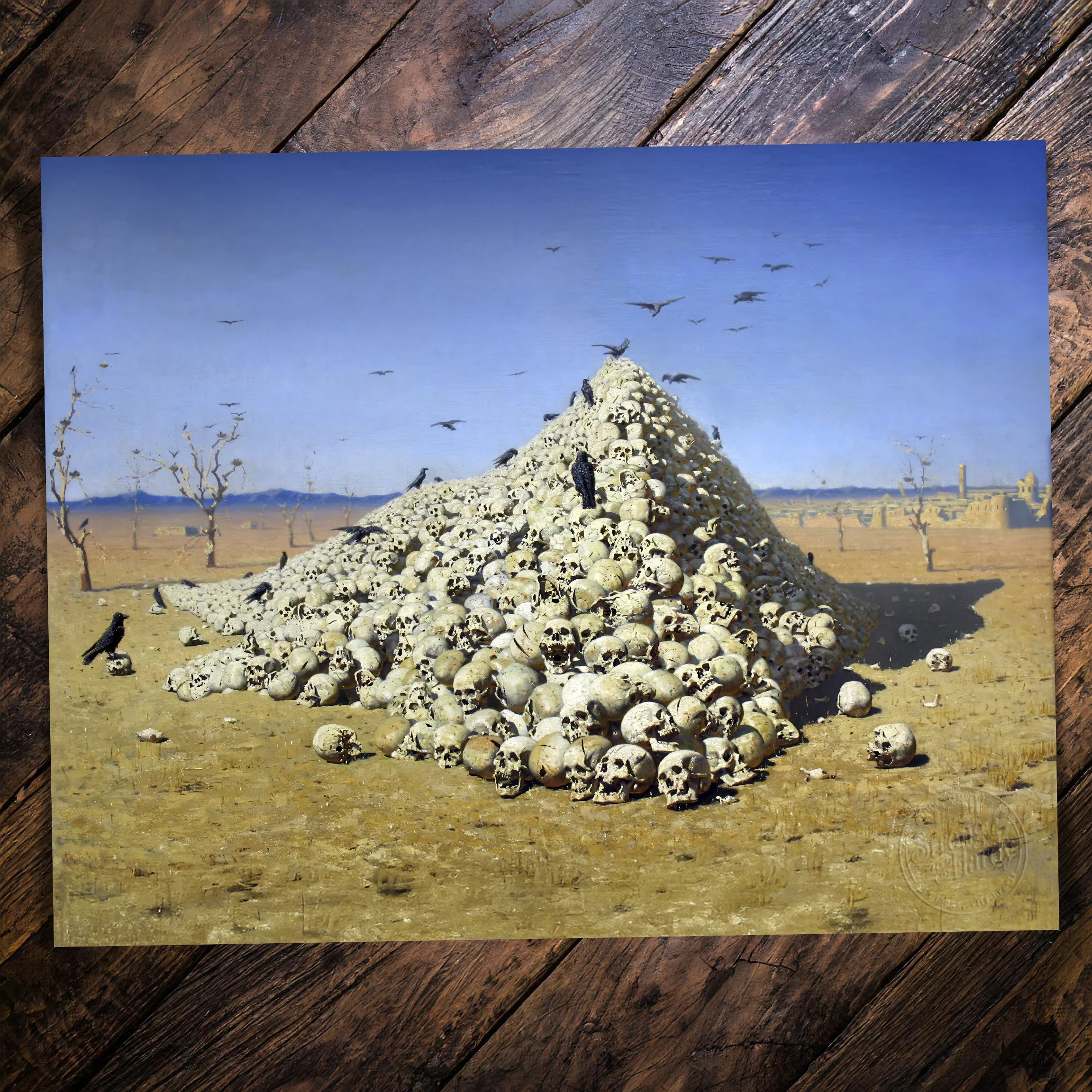
The Apotheosis of War by Vasily Vereshchagin, 1871
There are no victors here. No flags. No triumphant generals on horseback. No polished speeches about liberty, peacekeeping, or noble sacrifice.
Only bones.
The Apotheosis of War, painted in 1871 by Vasily Vereshchagin, is one of the most merciless anti-war paintings ever created. Vereshchagin, a Russian war artist and soldier, had witnessed firsthand the devastation of imperial military campaigns in Central Asia. Rather than glorify conquest, he chose to document its aftermath with brutal honesty.
His dedication is famously sharp:
“To all great conquerors—past, present, and to come.”
Not admiration. Accusation.
At the center of the painting stands a pyramid of human skulls beneath a pitiless sky. The earth is barren, scorched, and emptied of life. Crows circle overhead and pick through what remains. In the distance, the walls of a city crumble into the horizon. There are no soldiers left to celebrate victory, because this is victory. This is the final monument empire builds for itself.
The title itself is bitterly ironic. “Apotheosis” suggests glorification, ascension, the elevation of war into something sacred or heroic. Vereshchagin strips that illusion bare. There is no glory here; only rot, silence, and the arithmetic of mass death.
It was a dangerous painting to make.
Russian authorities were not eager to embrace an artist who refused patriotic mythmaking. His work was often criticized for being too bleak, too honest, too unwilling to serve nationalism. But that refusal is exactly why the painting still matters. It does not allow distance. It does not let viewers hide behind abstractions like strategy, defense, or destiny.
And in 2026, it feels less like history and more like current events.
The United States has long perfected the language of moral camouflage. War is rarely sold as conquest; it arrives dressed as freedom, democracy, liberation, security, humanitarian intervention. The branding changes. The outcome does not.
Iraq was liberation.
Afghanistan was stability.
Vietnam was containment.
Every intervention arrives with its own polished vocabulary designed to make violence feel necessary, even righteous.
And still, the ending keeps repeating itself:
cities reduced to rubble,
generations displaced,
civilian bodies counted like collateral footnotes.
The same logic echoes now across Gaza, where entire neighborhoods have been erased under the language of defense and security. Tens of thousands of Palestinians have been killed and the humanitarian collapse continues to deepen, even during fragile ceasefire periods.
At the same time, the expanding U.S.–Israel conflict with Iran has pushed the region further toward catastrophe: airstrikes, retaliation, political collapse, and the familiar insistence that escalation is somehow the path to peace. Reuters reports that after the recent war with the U.S. and Israel, power inside Iran has shifted further toward military hardliners, with the IRGC consolidating control.
Freedom.
Democracy.
Security.
These words are often presented as moral absolutes, but history asks harder questions:
Freedom for whom?
Democracy for whom?
Security purchased with whose bodies?
Vereshchagin answers without speaking.
A pile of skulls is wonderfully bipartisan.
It does not care which anthem played before the bombs fell.
It does not remember who claimed divine authority.
It does not distinguish between empire and resistance once the flesh is gone.
Only the dead remain.
That is what makes The Apotheosis of War endure. It refuses the romance of violence. It rejects the seductive aesthetics of military pride. It reminds us that war, stripped of uniforms and slogans, is not strategy.
It is absence.
It is mothers without children.
Cities without civilians.
Land without birdsong.
History written in ruins.
And eventually, if left unchecked, it is just a monument of bones standing under an empty sky—dedicated, as always, to all great conquerors, past, present, and to come
