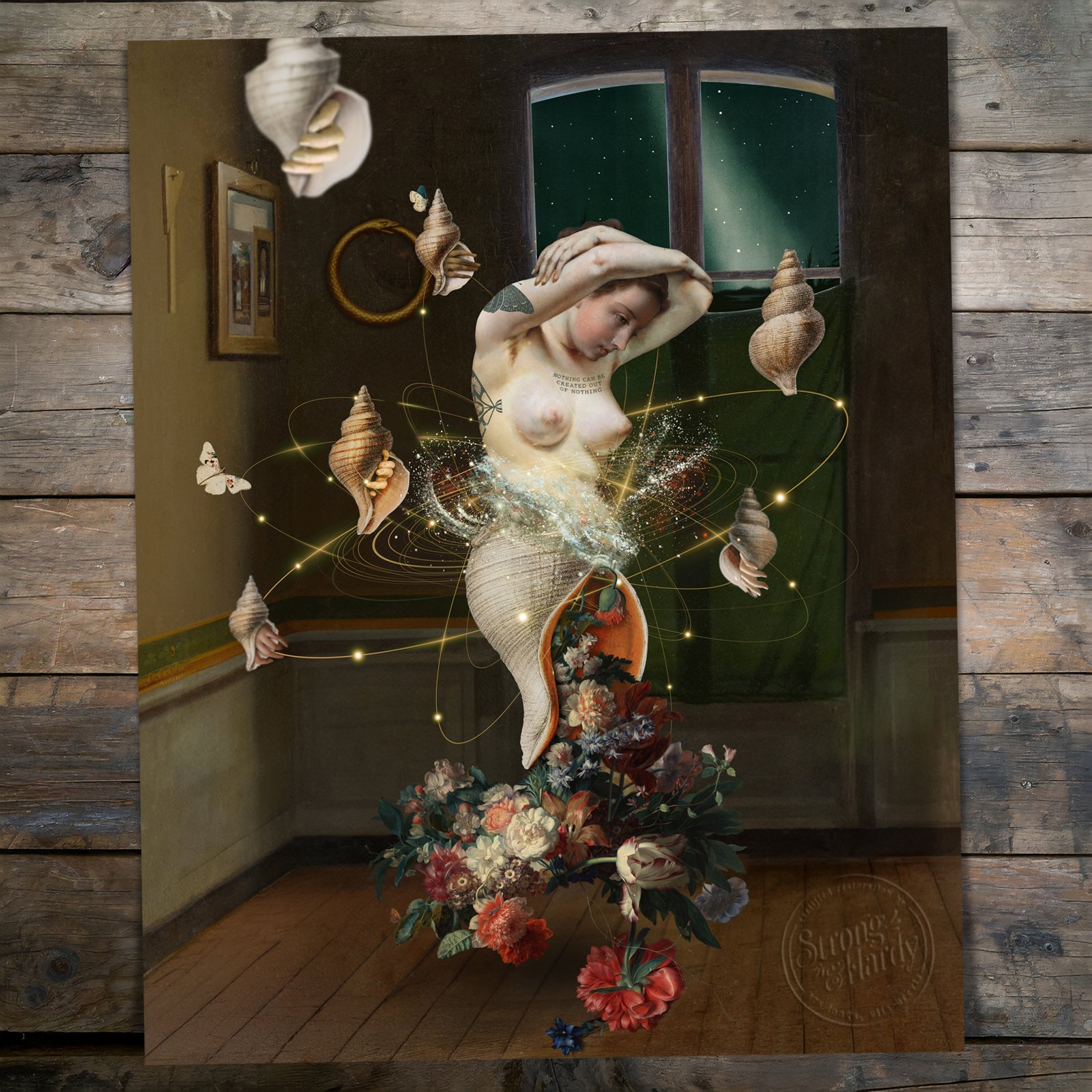
Ataraxia
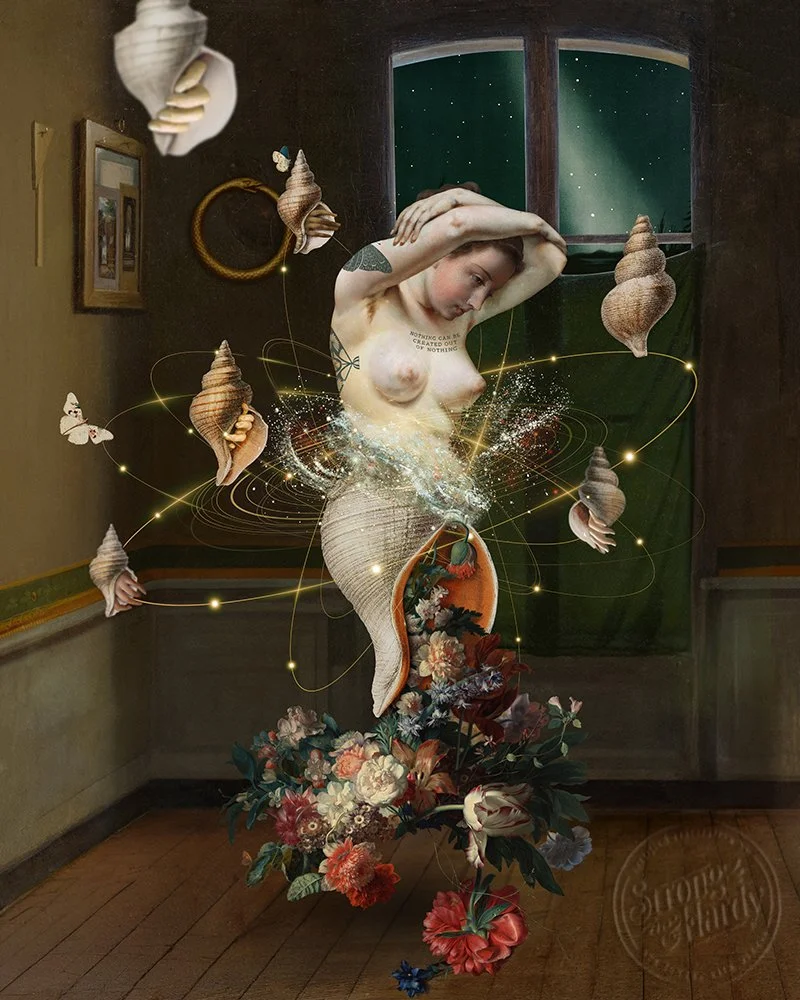
Ataraxia by Rebecca Tillett, Strong and Hardy
The Matter Remains
Ode to De Rerum Natura (On the Nature of Things) by Lucretius
BY REBECCA TILLETT
Nothing is ever begotten of nothing by divine will. Be there no end and no beginning. Be not afraid of death nor the anguish and suffering that encircles it. The air is thick with the carrying on of all things. You will carry on. Not in the abode of God but in everything and everything is god. The love you felt and that was felt for you will carry on. As water crashing against a shore, as a nervous sigh falling from the lips after the first ‘I’m sorry,’ as grief, as a protostar in a stellar nursery. Bodies are formed and broken, but the matter remains. You are inherited. You are inhabiting a shell for a particle lifetime. These bodies aren’t new, just atoms rearranged. One thing must pass away that others may arise. The sun is setting. The moon is rising. The moon is setting. And on and on. The Milky Way smells like rum and raspberries. Fear is as dense as a neutron star. Nothing begins. Nothing ends. Nil fieri ex nihilo, in nihilum nil posse reverti. Nothing can be produced from nothing, and that nothing can be reduced to nothing.
The quote on the subject’s chest, “Nothing can be created out of nothing” comes from the Roman philosopher Lucretius in his work De Rerum Natura (around 50 BCE).
At its core, it means: Nothing just appears out of nowhere—everything comes from something that already exists.
Lucretius was building on earlier ideas from Epicurus and early atomic theory. He believed the universe is made of tiny, eternal particles (atoms), and everything we see is just those particles rearranging, not being magically created or destroyed.
Put simply:
You can’t get something from nothing
Matter isn’t created—it transforms
Change is real, but creation from nothing isn’t
Ataraxia is a digital art collage created with human hands utilizing these historical sources:
The Woman in the Waves by Gustave Courbet. Oil on canvas. 1868
The Sense of Sight by Philippe Mercier. Oil on canvas. 1744
The Drawing Lesson by Pierre Duval Le Camus. Oil on canvas. 1826
Molluscs of the Northern Seas from Résultats des Campagnes Scientifiques by Albert I, Prince of Monaco. Medium unknown. 1848-1922
Ornament with diamond shape (Ornament met ruitvorm) by Samuel Jessurun de Mesquita. Woodcut. 1905
Vase of Flowers by Jan van Huysum. Oil on panel. 1722
The Zodical Light by E. L. Trouvelot. Chromolithograph. 1881
Woman with a Parrot by Gustave Courbet. Oil on canvas. 1866
Marie Joséphine Charlotte du Val d'Ognes by Marie-Denise Villers. Oil on canvas. 1801
Mary Magdalene by Jan Boeckhorst and Style of Anthony van Dyck. Oil on panel. 1650
The Virgin and Child by Antonello da Messina. Oil on panel. 1460
Forest Floor Still Life by Karl Wilhelm De Hamilton. Oil on panel. 1735