

From the Vaults of the Unhinged: The Art of the Automaton
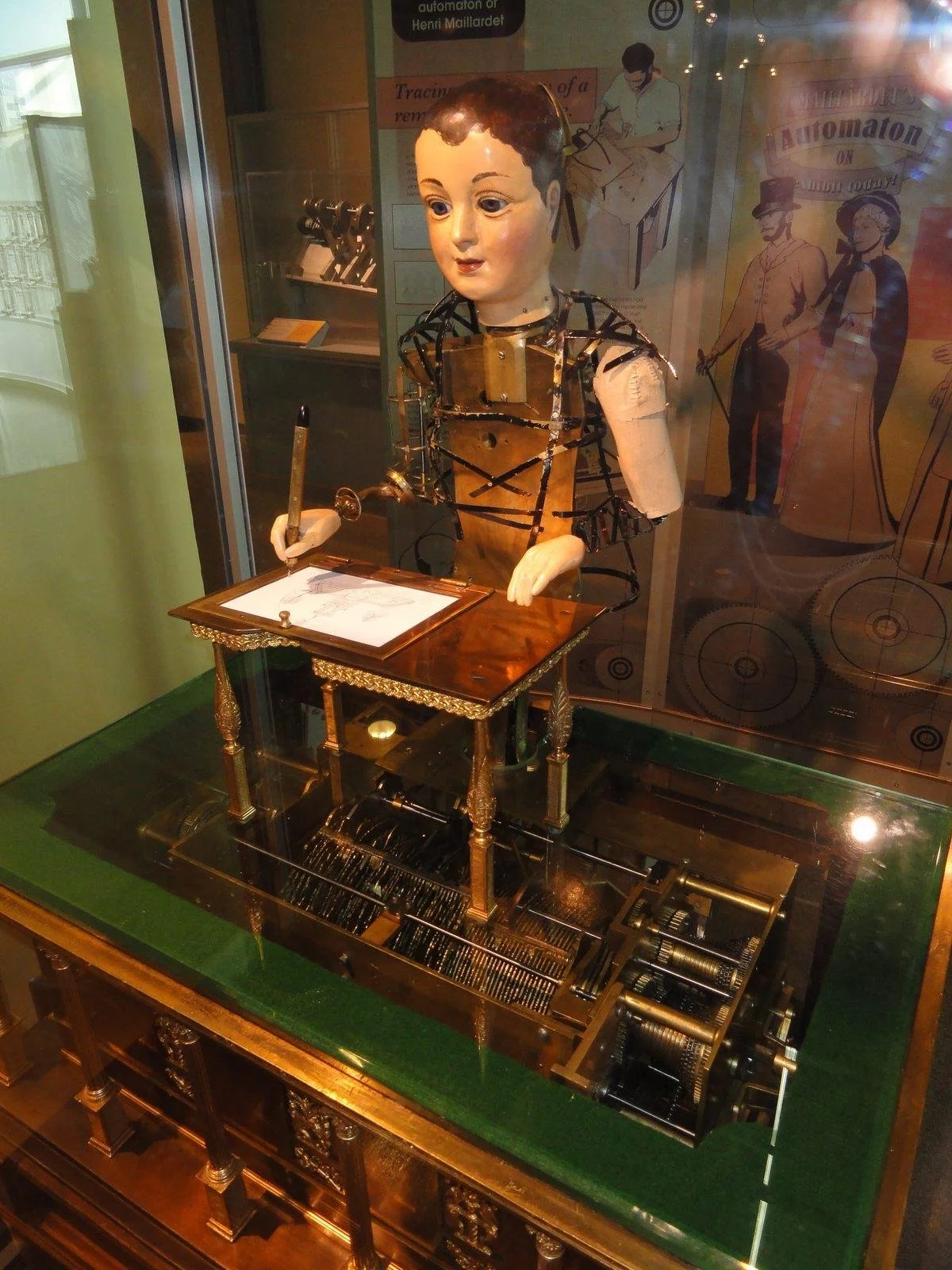
Draughtsman-Writer, automaton created by Henri Maillardet circa 1800, at The Franklin Institute since 1928
When machines tried to be human
Long before anyone was arguing about whether artificial intelligence could make art, people were building machines that could write poems, draw pictures, play musical instruments, and imitate the movements of living creatures.
And some of them were pretty damn creepy.
During the 18th and 19th centuries, automata—self-operating mechanical figures powered by intricate systems of gears, cams, springs, and levers—became objects of fascination throughout Europe. They were technological marvels, works of art, entertainment, and philosophical experiments all rolled into one. Their creators weren't simply trying to build machines that moved. They were trying to build machines that behaved like us.
That distinction matters.
One of the most extraordinary examples is the Draughtsman-Writer, an automaton built around 1800 by Swiss mechanician Henri Maillardet. At first glance, it looks like a mechanical child sitting at a desk. Set the machinery in motion, however, and the figure lowers its head, positions a pen, and begins to draw or write.
The machine can produce four drawings and three poems—two in French and one in English. Its "memory" isn't anything like the digital memory we think of today. Instead, the patterns are encoded physically in a series of brass cams hidden inside the cabinet beneath the figure. As the cams turn, metal fingers trace their irregular edges and translate those movements through an elaborate system of rods and levers into the movements of the automaton's hand.
It's an astonishing piece of engineering.
It's also a remarkably good illustration of a question humans have been asking for a very long time:
If a machine can produce something that looks like something a human made, what exactly is it doing?
The fascination with automata wasn't limited to writing and drawing. Inventors created mechanical musicians capable of playing instruments, figures that could write messages, and even machines designed to imitate biological processes. Jacques de Vaucanson's famous 18th-century automata included a human-shaped flute player whose bellows and mechanical mouth actually reproduced the process of breathing to produce music. His infamous Digesting Duck was designed to flap its wings, eat grain, and produce what appeared to be digested waste.
These machines occupied a strange space between art and science. They were demonstrations of mechanical ingenuity, but they also forced people to think about what separated a living thing from a machine.
The idea wasn't entirely comfortable.
As mechanical figures became increasingly lifelike, writers began exploring the unsettling possibility that something artificial might imitate a human being so convincingly that we could no longer be certain where the imitation ended and the human began. The creepy doll and automaton stories of the 18th and 19th centuries—including E.T.A. Hoffmann's The Sandman—helped establish a literary tradition around that very fear. Later thinkers used these stories to explore the psychological unease created by things that appear almost human, but not quite.
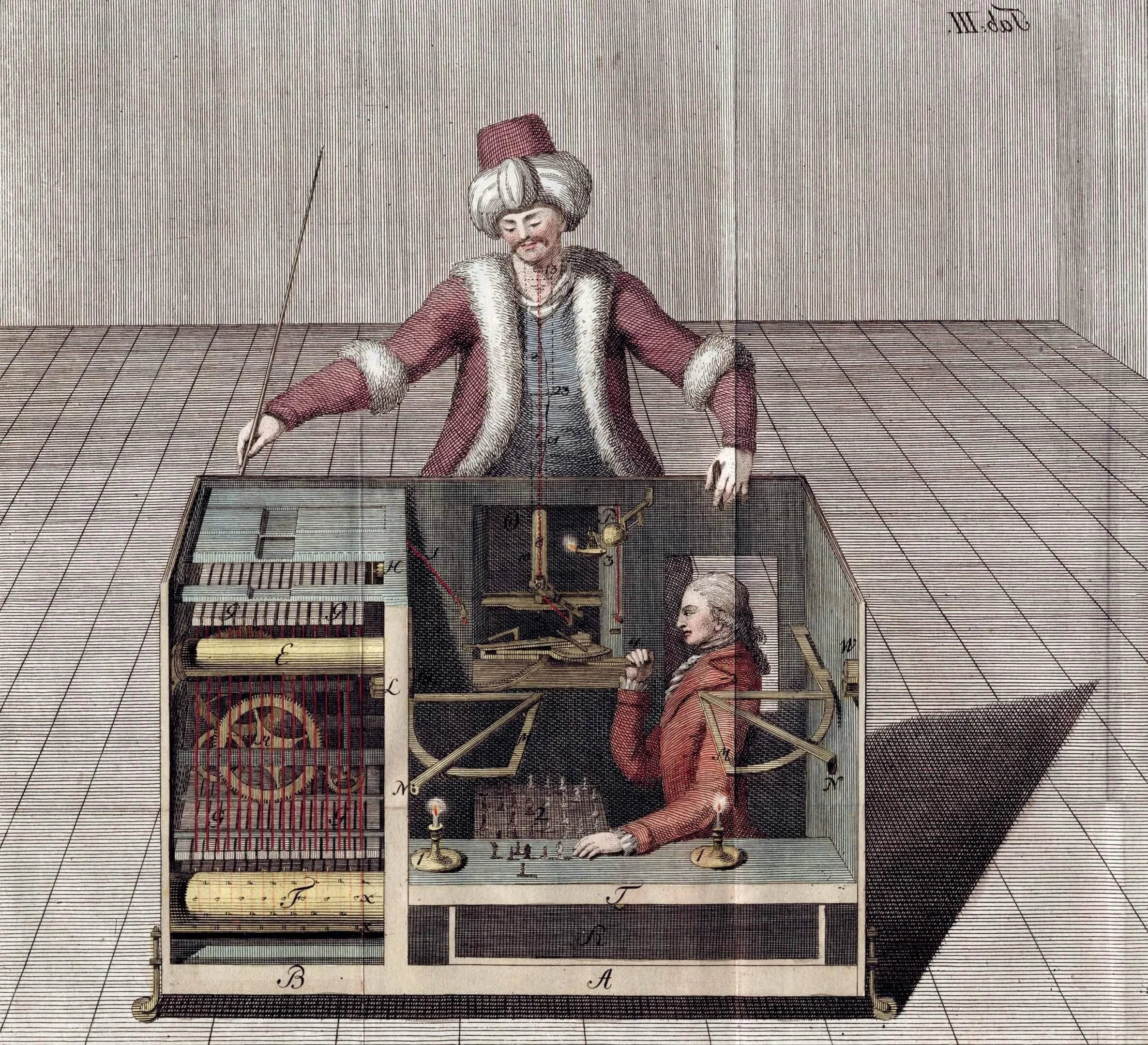
Mechanical Turk, late 18th century
And then there's the Mechanical Turk.
Built in the late 18th century, the famous "chess-playing automaton" toured Europe and America astonishing audiences by apparently playing chess against human opponents. The secret, of course, was that there was a human chess player concealed inside the cabinet. The machine wasn't intelligent at all; it was an elaborate illusion.
Yet the fascination surrounding it wasn't simply about the trick. During the Industrial Revolution, people were already wondering what kinds of human work machines might eventually be able to replace. When the Turk toured the United States in the 1820s, audiences were fascinated by the possibility that a machine might actually be capable of thinking.
Today, we're having remarkably similar conversations about artificial intelligence.’
And yes, artificial intelligence also helped research this subject for this post. Top tier irony anyone?
The technology is obviously different. A clockwork automaton follows a physical sequence of movements encoded into gears and cams. A modern generative AI system operates through vastly more complicated computational processes. One isn't secretly thinking inside a cabinet, and the other isn't waiting for someone to wind a key.
But the underlying fascination is surprisingly familiar.
We build machines that imitate things we once considered uniquely human. We teach them to produce language, images, music, and other forms of creative output. Then we find ourselves asking what that output means and whether the process behind it matters.
If a machine produces a beautiful drawing, is it art? As a human artist, I feel neurotically compelled and obligated to proclaim ‘no’ here. I’m sorry. Did I say ‘proclaim’ ? I meant: scream wildly from the rooftops like a rabid banshee.
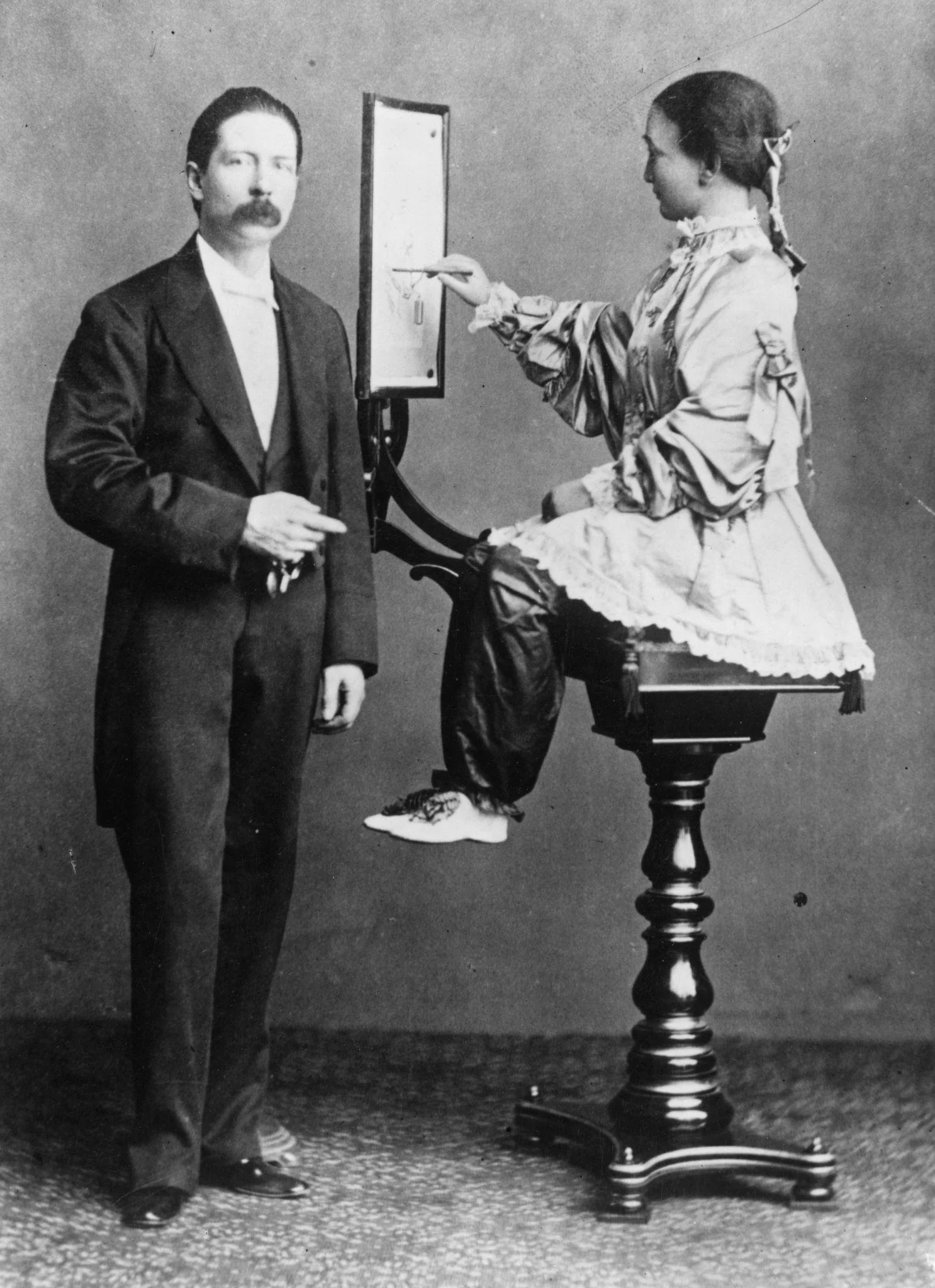
Zoe, the "writing and drawing automaton" presented by British magician and illusionist John Nevil Maskelyne around 1877. The photograph shows Maskelyne beside Zoe, who was designed to appear to draw portraits or reproduce handwriting on command. However, Zoe was a fake.
Her movements weren't generated autonomously by some miraculous mechanical brain. A hidden human assistant operated her through a concealed mechanism/pantograph. The audience saw a mechanical woman apparently drawing by herself, while the actual artist was concealed from view.
If it writes something that moves us, does it matter that it doesn't experience emotion? Again, from my perspective as a biological creature that experiences pain, joy, grief….yes. Yes. it matters.
If a machine can imitate the visible result of creativity, where does creativity actually live?
Ahem, in our very souls, but I digress…
These aren't new questions. We've simply built a much more sophisticated machine with which to ask them.
There's something particularly fitting about the Maillardet automaton's story. When the damaged machine was donated to the Franklin Institute in 1928, no one there initially knew exactly what they had. After it was painstakingly repaired, they set its mechanism in motion.
The machine began to draw.
After completing its drawings and poems, it revealed its own identity in the border around its final poem: "Ecrit par L'Automate de Maillardet"—"Written by the Automaton of Maillardet." The machine's own mechanical output helped researchers identify what it was and who had built it.
A machine made to imitate a human act had, in a sense, left behind its own signature.
Two centuries later, we're still fascinated by that boundary between making and imitation, mechanism and creativity, human and machine.
Maybe that's the real reason automata still feel so uncanny.
They don't just look like us.
They make us examine and question what, exactly, makes us different.
