

Judith Beheading Holofernes
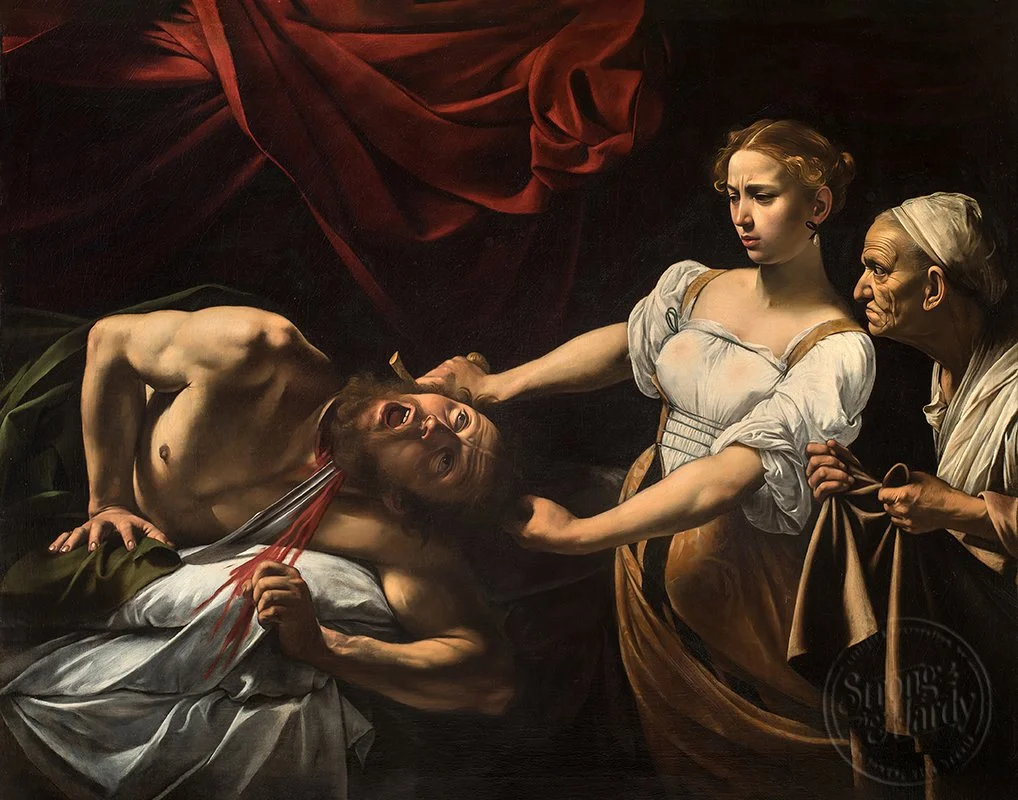
Judth Beheading Holofernes by Michelangelo Merisi da Caravaggio, 1600
Caravaggio had a way of making stories feel uncomfortably real. Rather than idealizing his subjects, he often painted people as they actually looked: tired, imperfect, frightened, or caught in the middle, of a situation, or in the middle of doing something. The chiascuro - the strong contrasts between light and darkness - put his figures in spaces that can feel remarkably close to the viewer.
Judith Beheading Holofernes, painted in about 1600, is one of the clearest examples. The story comes from the most ancient Greek translation of the Old Testament’s Book of Judith, in which a widow from the besieged city of Bethulia, enters the camp of the Assyrian general Holofernes, pretending to be first a pragmatist and possible traitor. After gaining his confidence, via charm, wile and attraction, and after being invited to his tent for a meal, she uses that trust; he wants her, but instead drinks himself to sleep, and she decapitates him with his own sword. Caravaggio doesn't show the lead-up or aftermath. He shows the killing itself, with Holofernes still alive, and reacting to what is happening as it happens.
Judith isn't celebrating what she is doing, but she isn't frozen with fear. She is focused on finishing the task, and even disgusted by the necessity. Beside her is her maidservant, or abra, who waits with a sack for Holofernes's head. Holofernes occupies much of the painting, his body twisting across the bed with his realization.
Caravaggio also makes the physical effort of the act part of the scene. Judith has to push against Holofernes's body as she works, while he struggles to pull himself away. Holofernes, powerful and helpless, and Judith, vulnerable but in absolute control. Abra watches, ready to carry out the next part of the plan.
The dark makes the confrontation that much more intense. There is almost no background to distract, and the light falls directly across their faces, bodies, and the bed. There’s no distance between the viewer and the violence.
The story presents Judith as a hero to her people, but Caravaggio gives her expression doubt, rather than the look of someone enjoying a victory. There is concentration, effort, and even reluctance in her face. Nor is Holofernes a faceless villain; he is a living man with a sudden sober awareness that he is about to die.
‘Good defeating evil’ is never so simple. Caravaggio puts the viewer close enough to see the fear, strain, and reality of what is occurring. The story is about a young woman saving her people, but the painting makes the cost impossible to ignore.
21: When those days were over, all of them returned to their inheritance. Judith went back to Bethulia and remained on her estate. For the rest of her life she was renowned throughout the land.
22: Many wished to marry her, but she gave herself to no man all the days of her life…
23: Her fame continued to increase, and she lived in the house of her husband, reaching the advanced age of one hundred and five.
The Book of Judith
