

From the Vaults of the Unhinged: When Photography Tried to Capture the Dead
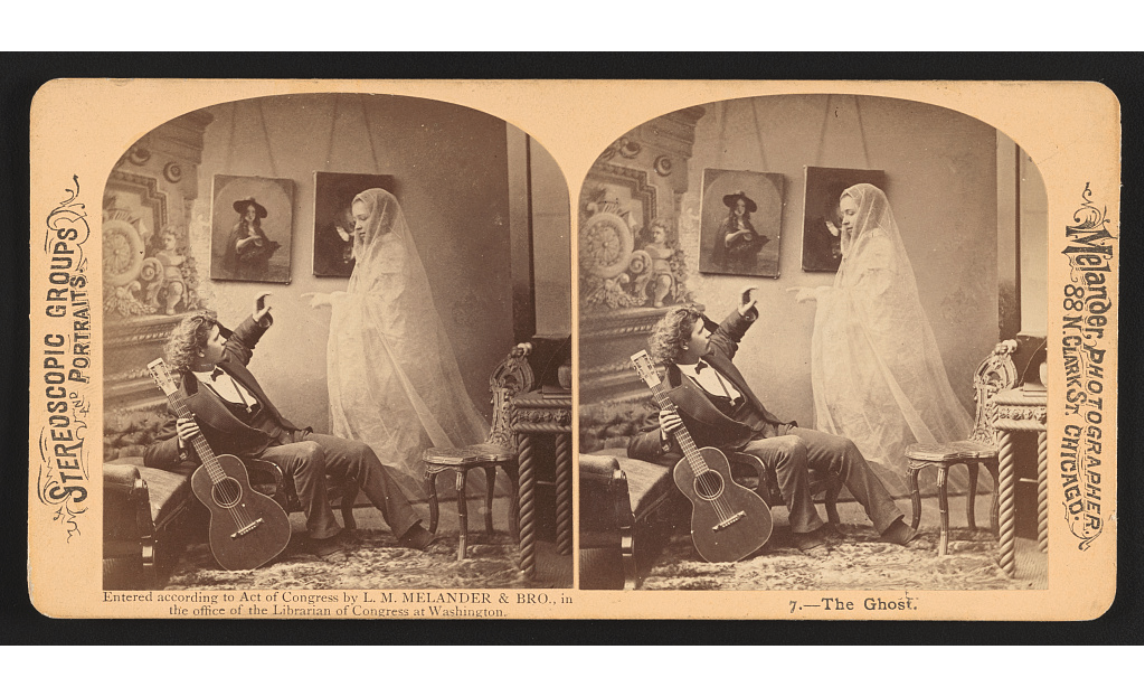
The Ghost, Melander & Bro., 1874
In the 1870s, photography was still a relatively new technology and, to many people, it seemed almost magical. A camera could preserve a person's face forever, capture a moment no human eye could hold onto, and produce a physical image from light alone.
So naturally, someone eventually asked the next logical question:
Could it photograph a ghost?
The answer, according to a growing number of photographers in the late 19th century, was apparently yes.
Known as spirit photography, the practice emerged alongside the Spiritualist movement, which held that the spirits of the dead continued to exist and could communicate with the living. In the aftermath of the American Civil War, when hundreds of thousands of families had lost loved ones, the promise of seeing a deceased relative again held enormous emotional appeal.
Photographers began producing portraits in which translucent figures appeared alongside their living subjects. Sometimes the spirits looked like deceased family members. Sometimes they hovered mysteriously in the background. Sometimes they were little more than vague faces or glowing forms.
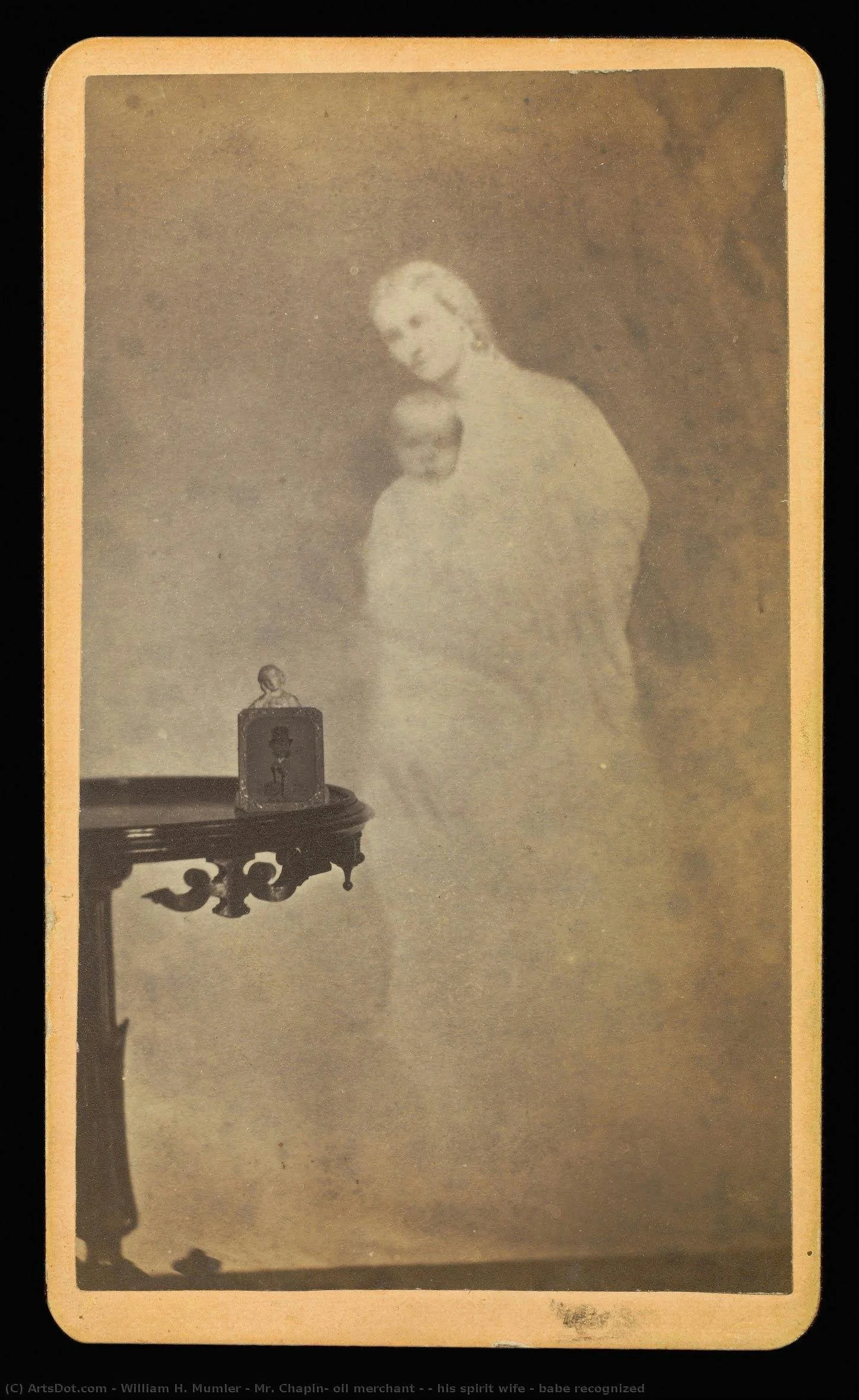
Mr. Chapin by William H. Mumler, 1875
And sometimes they were, quite literally, people who were still alive.
One of the most famous names in spirit photography was William H. Mumler, a Boston photographer who began producing these images in the 1860s. Mumler claimed that the ghostly figures appearing in his photographs were spirits who had presented themselves to his camera. His photographs became popular enough that grieving customers were willing to pay significant sums for the chance to have their portrait taken with a departed loved one.
Not everyone was convinced.
Photographers already knew that techniques such as double exposure, composite negatives, and superimposition could produce exactly the sort of ghostly effects being presented as supernatural evidence. In fact, the Library of Congress notes that instructions for creating a “spirit” photograph through photographic manipulation had been published as early as 1856—before spirit photography became a widespread commercial phenomenon.
Mumler eventually found himself facing accusations of fraud. During his 1869 trial, critics produced evidence that at least one supposed spirit resembled a living Boston resident. He was acquitted, but his career as a spirit photographer never fully recovered.
And yet the photographs continued.
The image that inspired this month's From the Vaults of the Unhinged comes from the Library of Congress: a stereograph simply titled The Ghost, published by Melander & Bro. in 1874. The photograph is part of the Library's collection of 19th-century spirit photographs.
Stereographs were designed to be viewed through a stereoscope, creating the illusion of three-dimensional depth from two slightly different photographs. In this case, the ordinary technology of the stereograph was paired with the extraordinary suggestion that another world had somehow appeared inside the picture.
Today, we know that photographic techniques could create these apparitions without any assistance from the afterlife. But dismissing spirit photography as nothing more than a collection of hoaxes misses something important.
People weren't simply trying to fool one another.
For many, these photographs offered the possibility of proof that death wasn't the end. At a time when photography itself was still mysterious, the camera seemed like a machine capable of revealing things the human eye could not. If it could preserve the face of someone who had died, perhaps it could preserve something of them that remained.
The ghosts may have been manufactured.
The grief was real.
And perhaps that's what makes these strange old photographs so compelling more than 150 years later. They capture a moment when a brand-new technology collided with one of humanity's oldest desires:
to see the dead again.
And then there's the Mechanical Turk.
Built in the late 18th century, the famous "chess-playing automaton" toured Europe and America astonishing audiences by apparently playing chess against human opponents. The secret, of course, was that there was a human chess player concealed inside the cabinet. The machine wasn't intelligent at all; it was an elaborate illusion.
Yet the fascination surrounding it wasn't simply about the trick. During the Industrial Revolution, people were already wondering what kinds of human work machines might eventually be able to replace. When the Turk toured the United States in the 1820s, audiences were fascinated by the possibility that a machine might actually be capable of thinking.
Today, we're having remarkably similar conversations about artificial intelligence.’
And yes, artificial intelligence also helped research this subject for this post. Top tier irony anyone?
The technology is obviously different. A clockwork automaton follows a physical sequence of movements encoded into gears and cams. A modern generative AI system operates through vastly more complicated computational processes. One isn't secretly thinking inside a cabinet, and the other isn't waiting for someone to wind a key.
But the underlying fascination is surprisingly familiar.
We build machines that imitate things we once considered uniquely human. We teach them to produce language, images, music, and other forms of creative output. Then we find ourselves asking what that output means and whether the process behind it matters.
If a machine produces a beautiful drawing, is it art? As a human artist, I feel neurotically compelled and obligated to proclaim ‘no’ here. I’m sorry. Did I say ‘proclaim’ ? I meant: scream wildly from the rooftops like a rabid banshee.
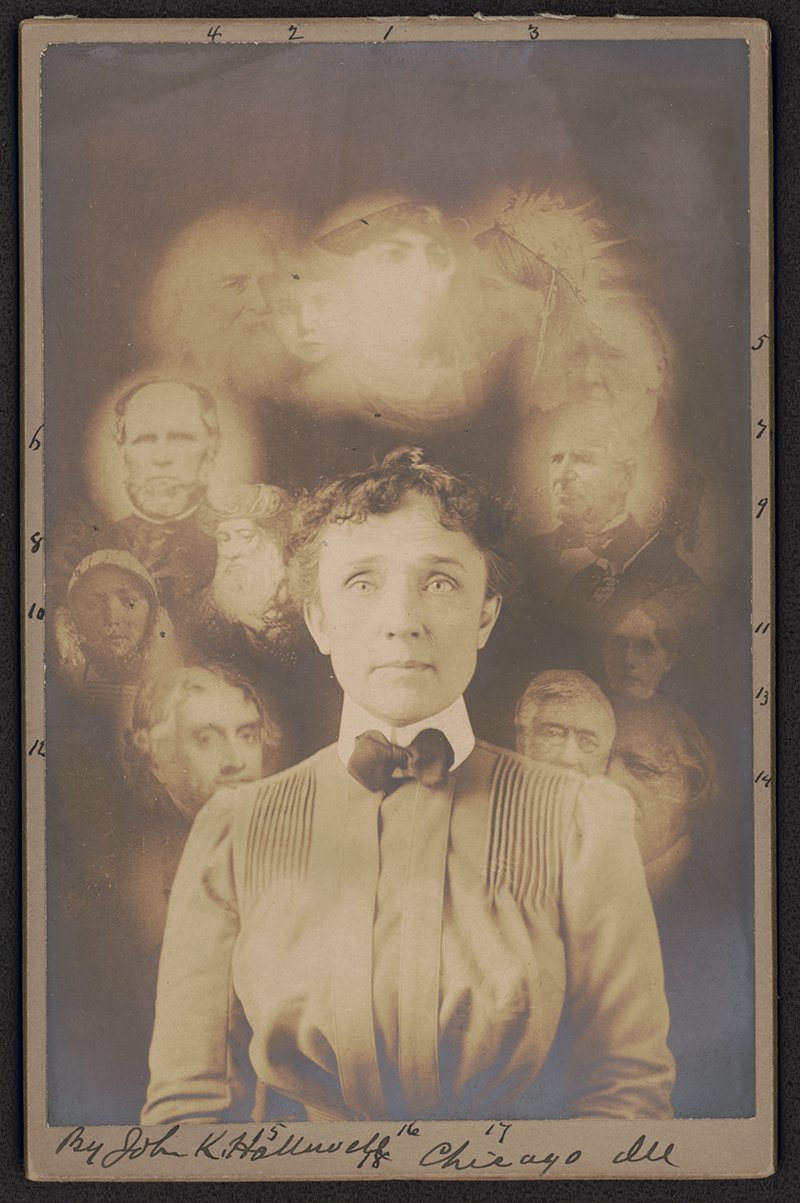
"Spirit" photograph, supposedly taken during a seance, actually a double exposure or composite of superimposed cut-outs, showing woman with portraits of men and women around her head by John K. Hallowell, Chicago, Ill. ; S.W. Fallis, photographer, Chicago. 1901
If it writes something that moves us, does it matter that it doesn't experience emotion? Again, from my perspective as a biological creature that experiences pain, joy, grief….yes. Yes. it matters.
If a machine can imitate the visible result of creativity, where does creativity actually live?
Ahem, in our very souls, but I digress…
These aren't new questions. We've simply built a much more sophisticated machine with which to ask them.
There's something particularly fitting about the Maillardet automaton's story. When the damaged machine was donated to the Franklin Institute in 1928, no one there initially knew exactly what they had. After it was painstakingly repaired, they set its mechanism in motion.
The machine began to draw.
After completing its drawings and poems, it revealed its own identity in the border around its final poem: "Ecrit par L'Automate de Maillardet"—"Written by the Automaton of Maillardet." The machine's own mechanical output helped researchers identify what it was and who had built it.
A machine made to imitate a human act had, in a sense, left behind its own signature.
Two centuries later, we're still fascinated by that boundary between making and imitation, mechanism and creativity, human and machine.
Maybe that's the real reason automata still feel so uncanny.
They don't just look like us.
They make us examine and question what, exactly, makes us different.
